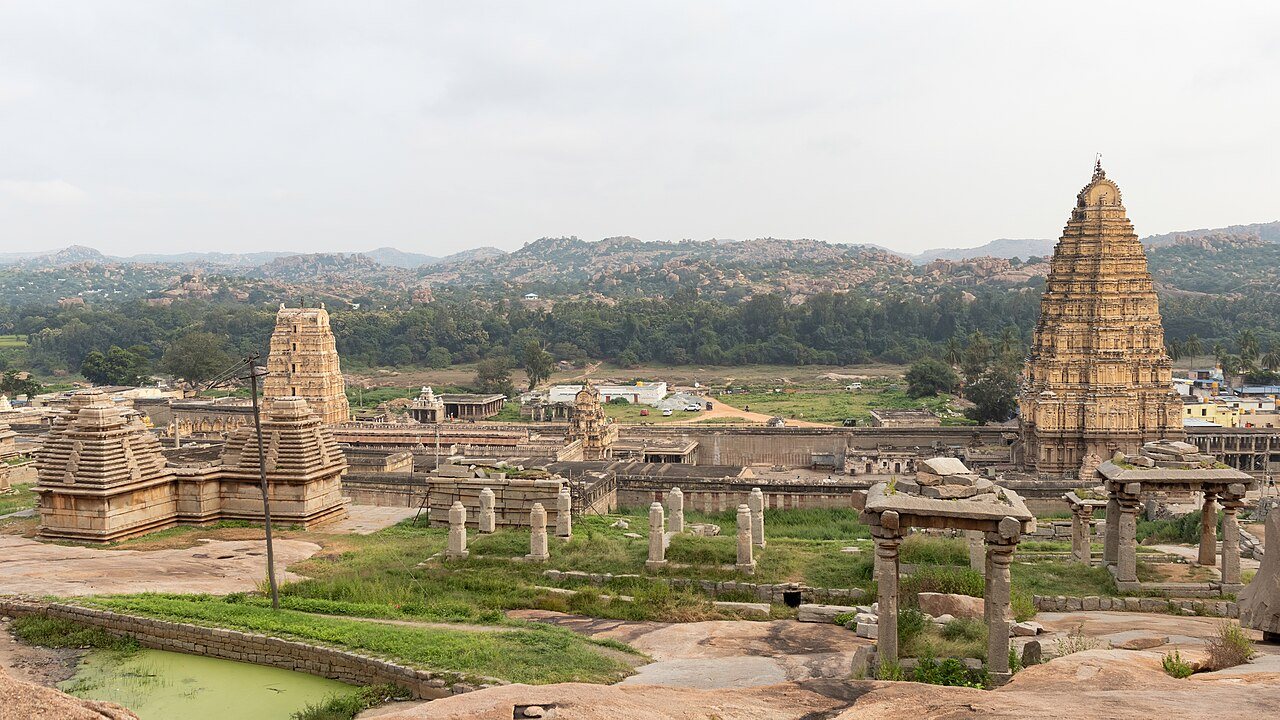
Virupaksha Temple monumental gopuram rising above the ancient granite boulder ruins of Hampi
🏛️ DESTINATION DISPATCH • DECCAN CHRONICLES

India Heritage Sites — Hampi, Indian Architecture and Sacred Landscapes

Across twenty-six square kilometers of the central Deccan plateau lies a surreal terrain of precariously balanced granite monoliths, river gorges, and the sprawling ruin of Vijayanagara—in 1500 CE, the second-largest metropolis in the medieval world. For international travelers, this section adds practical context to India travel.

1336–1565 CE Imperial Golden Age
3.8 Billion Yrs Precambrian Granite Age
500+ Monuments UNESCO World Heritage
Tungabhadra Sacred Pampa River
CHRONICLE I • DECCAN ORIGINS

The Boulders That Predate Memory — India Travel Guide

Long before Sangama princes Harihara and Bukka founded the empire of Vijayanagara in 1336 CE, this landscape belonged to geological deep time. The hills surrounding Hampi—Matanga, Anjanadri, Hemakuta, and Malyavanta—are composed of gray-pink porphyritic granite belonging to the Dharwar Craton, one of the oldest stable pieces of continental crust on Planet Earth, dating back nearly 3.8 billion years. For international travelers, this section adds practical context to India travel guide.

Over epochs of torrential monsoons and incandescent sun, spheroidal weathering cracked monolithic granite sheets into colossal rounded boulders. Stacked like marbles tossed by mythological giants, they defy gravity on hilltops. In the Ramayana, this terrain was revered as Kishkindha, the monkey kingdom of Sugriva and Hanuman, where stone caves offered shelter to exile Prince Rama as the monsoon clouds swept low across the Tungabhadra basin.

"The stones here do not feel like inert geology. They possess a patient, watchful stillness, as though they witnessed every ruby merchant, every invading horseman, and are simply waiting for the next dynasty to crumble."

When the architects of Vijayanagara looked upon these mounds of stone, they did not flatten them. Instead, they fused human masonry directly into living rock. Temple sanctuaria emerged out of natural boulder crevices; fortification walls stepped rhythmically over sheer cliffs; and water channels were chiseled directly across bare rock saddles without lime mortar.

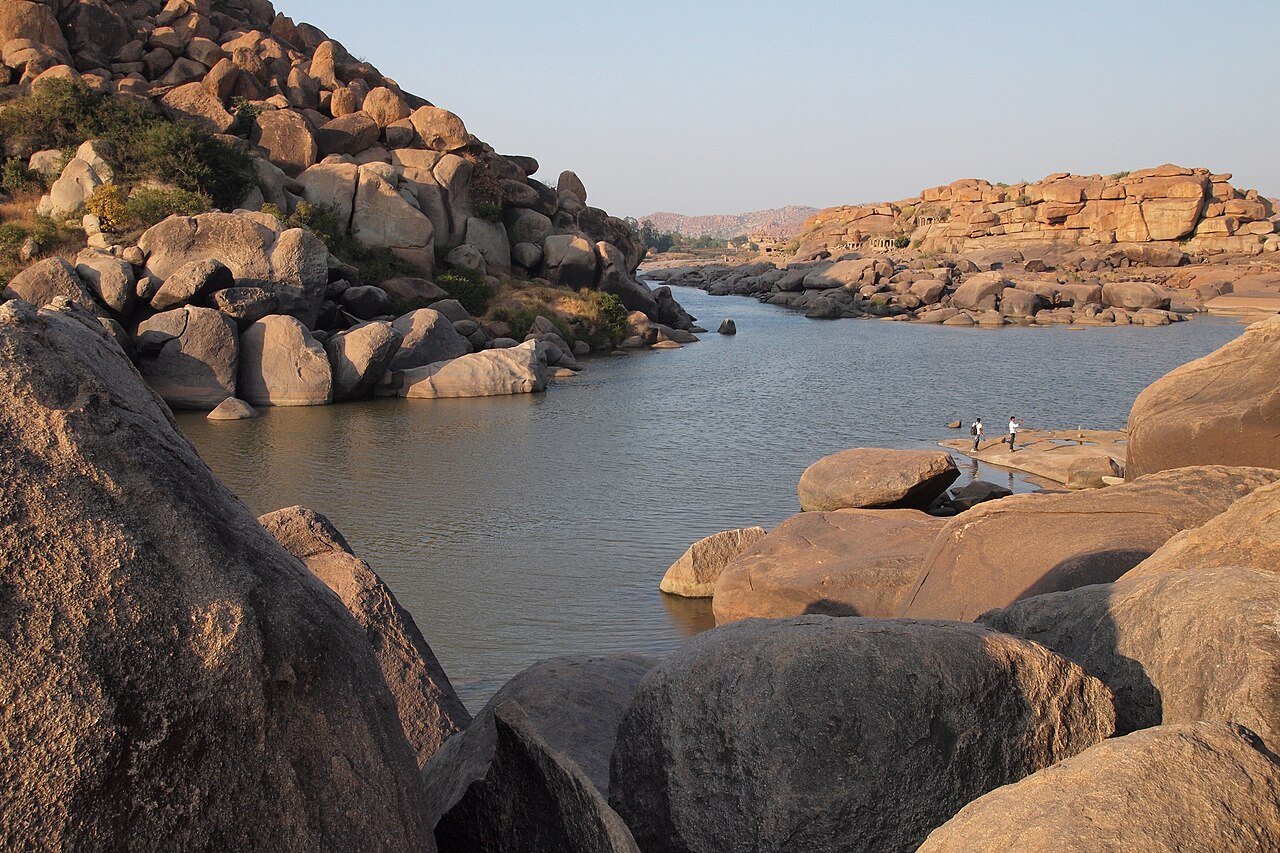
Round wicker coracle floating on the sacred Tungabhadra River beside massive Hampi granite boulders
THE SACRED TUNGABHADRA

Circular coracles (*harigolu*) woven from cane and waterproofed with buffalo hide have plied these swirling granite eddies since the Bronze Age.

CHRONICLE II • SACRED HYDROLOGY

The Tungabhadra at Dawn — India Tourism

At 5:30 AM, before the Deccan sun scorches the granite terraces, Hampi belongs to the river and the bells of Virupaksha. For international travelers, this section adds practical context to India tourism.

A silver mist hangs over the river bend at Chakratirtha, the sacred whirlpool where the Tungabhadra turns northward toward the Himalayas. Pilgrims step gingerly into the cool, dark waters, chanting the Gayatri Mantra while holding copper lotas to the rising sun. Across the bank, local boatmen haul their saucer-shaped coracles onto the rocks.

To cross the Tungabhadra in a coracle is a disorienting sensation. The craft spins gently with every stroke of the oar, gliding millimeter-close past jagged submerged granite reefs. King Krishna Deva Raya used fleets of these identical craft in the 1520s to ferry shock infantry, horses, and provisions across flooded rapids during campaigns against the Deccan Sultanates. Today, the crossing takes you to Anegundi—a peaceful village where rural courtyard life continues beneath date palms, older than the ruins themselves.

CHRONICLE III • ACOUSTIC WONDERS

The Musical Pillars of Vitthala — Travel To India

ARCHITECTURAL DOSSIER

Saptaswara: Lithic Resonances in Solid Rock — Visit India

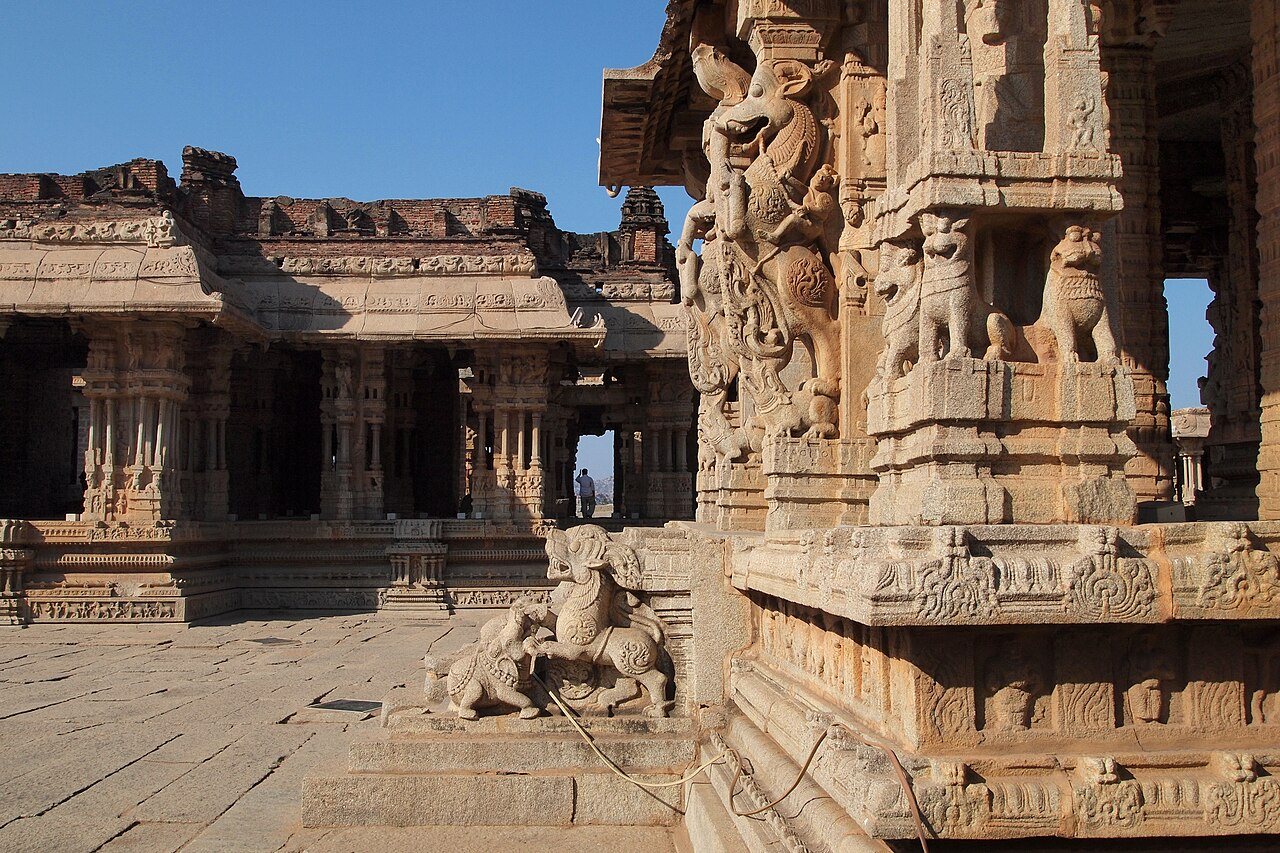
Inside the Mahamandapa of the 16th-century Vitthala Temple complex stand 56 monolithic granite pillars. Each major pillar is surrounded by seven slender micro-shafts chiseled from the same single block of stone. When gently struck with the thumb, these stone reeds produce distinct musical frequencies tuned to classical Carnatic notes: Sa, Ri, Ga, Ma, Pa, Dha, Ni. For international travelers, this section adds practical context to visit India.

British colonial engineers, bewildered by the acoustics, famously cut open two pillars in the 19th century to search for resonant hollow pipes or copper wires inside. They found only solid granite. The resonance was achieved purely through varying density, precise mineral crystalline orientation, and micro-calibrated pillar girths.

Intricate carved granite musical pillars of the Vijaya Vitthala Temple in Hampi
Musical Pillars of Vijaya Vitthala

Monolithic granite columns sculpted with slender micro-shafts tuned to resonate at classical Carnatic frequencies.

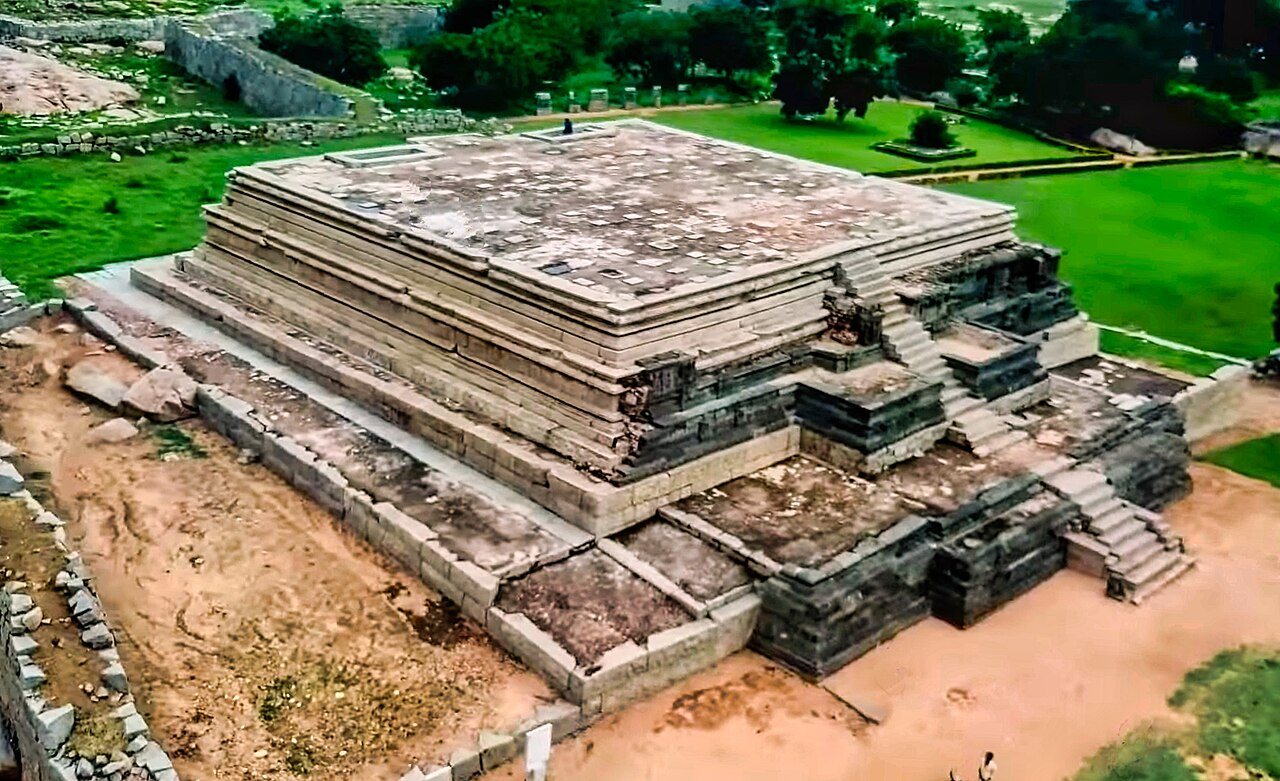
Elevated stone platform and ceremonial relief carvings at Mahanavami Dibba in Hampi
Mahanavami Dibba Reliefs

Multi-tiered granite platforms detailing royal processions, courtly dancers, and war elephants carved into Vijayanagara plinths.

CHRONICLE IV • INTERNATIONAL COMMERCE

The Bazaar Where Rubies Were Sold by the Liter — India Travel

In 1520 CE, Portuguese chronicler Domingo Paes visited Vijayanagara and wrote that it was as large as Rome, with gardens and orchards in the courtyards of the wealthy. For international travelers, this section adds practical context to India travel.

What stunned European, Persian, and Ottoman travelers most was the sheer scale of the open-air commodity trading along the half-mile-long colonnaded bazaar stretching out from Virupaksha Temple. In his memoir, Persian ambassador Abdur Razzaq wrote in astonishment:

"The jewelers sell their rubies, pearls, diamonds, and emeralds publicly in the bazaar... The common people wear gold ear ornaments set with stones, and flowers in their hair. In this city you find merchants from Venice, Persia, China, and Africa."

Today, the two-story stone arcades of Sule Bazaar still stand in silent dignity beside the Achyutaraya Temple. Where Persian horse merchants once bartered Arabian mares for Golconda diamonds, wild Deccan creepers now weave through the stone lintels. Walking through these colonnades at dusk, the acoustic silence is profound.

Key themes include India tourism, India spiritual tourism, Indian architecture, helping international travelers plan an informed and memorable journey.

EXPLORER BLUEPRINT

The Hampi Stone Compass — India Travel Guide

Six foundational architectural quadrants every foreign traveler should explore on foot: For international travelers, this section adds practical context to India travel guide.

QUADRANT 01 • SACRED RIVER

Virupaksha Temple Complex — India Spiritual Tourism

The only shrine in Hampi that has remained continuously active since the 7th century CE. Witness dawn temple elephant blessings (*Lakshmi*) and the pinhole-camera optical illusion inside the inner sanctum wall. This section helps visitors understand India spiritual tourism as part of a thoughtful India journey.

TIMING: 06:00 – 08:30 AM
QUADRANT 02 • IMPERIAL RHYTHM

Vitthala & The Stone Chariot — Travel To India

The pinnacle of Vijayanagara high art. Gaze upon the Garuda stone shrine styled as a battle chariot, whose carved granite wheels once turned freely on stone axles. For international travelers, this section adds practical context to travel to India.

TIMING: 08:00 – 10:30 AM
QUADRANT 03 • MONOLITHIC POWER

Ugra Narasimha & Badavilinga — Visit India

A 6.7-meter-tall monolithic avatar of Vishnu bursting from a pillar, carved in 1528 from a single granite boulder. Adjacent lies the monolithic Shiva linga sitting in fresh spring water. For international travelers, this section adds practical context to visit India.

TIMING: 10:30 – 11:30 AM
QUADRANT 04 • COURTLY ELEGANCE

Lotus Mahal & Elephant Stables — India Travel

Indo-Islamic syncretic design. Eleven domed chambers built to house royal tusker elephants, featuring Islamic cusped arches, plaster stucco rosettes, and passive water cooling channels. For international travelers, this section adds practical context to India travel.

TIMING: 03:30 – 05:00 PM
QUADRANT 05 • HIGH PANORAMA

Matanga Hill Summit Path — India Travel Guide

A 20-minute rock stairway ascent leading to the rooftop of the Deccan. As the sun sinks behind Hemakuta, the entire boulder landscape glows molten bronze and amethyst. For international travelers, this section adds practical context to India travel guide.

TIMING: 05:15 – 06:45 PM
QUADRANT 06 • NORTH OF THE GORGE

Anegundi & Sanapur Lake — India Tourism

Cross the river via coracle or bridge into the rural hinterland. Discover Neolithic rock art shelters, quiet bouldering sanctuaries, and palm-shaded organic cafes. For international travelers, this section adds practical context to India tourism.

TIMING: FULL AFTERNOON RETREAT
FIELD NOTES • INTERNATIONAL VISITOR CODE

Practical Field Intelligence for Walking Hampi — Travel To India

🚆 Reaching Hampi

The nearest railway hub is Hosapete (HPT), 13 km away. Excellent overnight express trains link Hosapete directly with Bengaluru (Hampi Express), Goa (Amaravati Express), and Hyderabad. Auto-rickshaws from Hosapete to Hampi Bazaar cost approximately ₹250–₹350. For international travelers, this section adds practical context to travel to India.

☀️ Heat & Walking Hours

Granite absorbs and radiates immense thermal heat. Explore strictly between 06:00 – 10:30 AM and 04:00 – 06:45 PM. Rest during midday in stone mandapas or river-view cafes. Always carry 2 liters of electrolyte water and wear thick cotton socks for walking on scorching temple courtyards where shoes are forbidden.

🥾 Bicycles & Mopeds

Renting a single-speed geared bicycle (₹150/day) is the single best way to absorb the royal center at human pace. On the northern (Anegundi) side of the river, rental automatic scooters (₹350–₹500/day + petrol) allow easy access to Sanapur Lake and monkey shrines.

🙏 Temple Etiquette & Footwear

Virupaksha is a living, sacred place of worship. Knees and shoulders must remain covered for all visitors. Remove footwear outside shrines. A tip of ₹20 to the temple shoe custodian is customary. Do not touch or tap musical pillars in Vitthala; conservation guards strictly enforce preservation.

CONNECTED DISPATCH

Kolkata Travel & Heritage — Indian Architecture

Journey next from the medieval Deccan boulder kingdom to the intellectual, riverine heart of Bengal—where vintage wooden trams and unhurried cafe debates define daily life. International travelers can use this section when exploring Indian architecture.

READ NEXT DISPATCH→
EXPAND YOUR HORIZONS

Deccan & Central Heritage: Monoliths & Cave Temples — India Heritage Sites

Traverse the wider Deccan Plateau, early Chalukya rock sanctuaries in Badami, and monolithic rock-cut shrines at Ellora. International travelers can use this section when exploring India heritage sites.

Explore Deccan Hub →